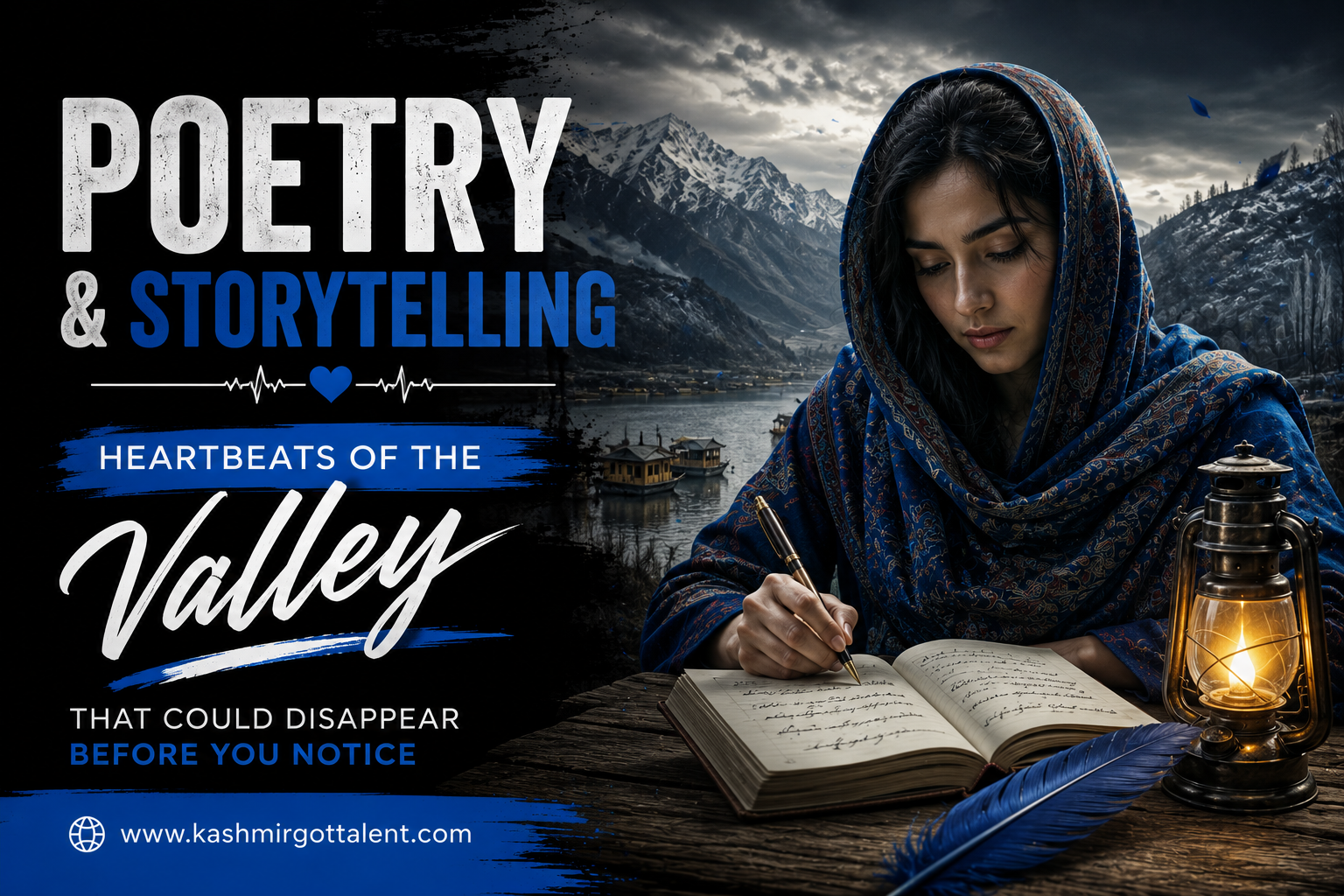
The Valley Does Not Speak Loudly — It Whispers Through Poetry and Memory
There are places in the world where history does not sit inside books. It breathes through wind, through old pathways, through voices that never learned to become headlines. The valley is one of those places.
Here, storytelling is not entertainment. It is survival.
Every poem carries the weight of generations who never had microphones. Every story is a bridge between what was lost and what still refuses to die. And yet, these voices are slowly fading—not because they are unimportant, but because the world is moving too fast to listen.
This is not just culture. This is living memory at risk.
Why Poetry and Storytelling Still Matter in a Digital-First World
We live in an era where attention is measured in seconds. But poetry does not work in seconds. It works in silence, reflection, and emotional depth.
In the valley, poetry is not written to impress. It is written to remember.
It remembers love that never got closure. It remembers displacement that never made it to textbooks. It remembers homes that exist only in imagination now.
Storytelling, in its rawest form, is not content. It is identity.
And when identity is not preserved, it does not vanish loudly. It disappears quietly.
The Heartbeats Hidden Inside Every Local Story
Every valley has its rhythm. But not everyone hears it.
The rhythm exists in:
- The grandmother who still tells stories in a language no longer taught in schools
- The farmer who knows land not by maps, but by memory
- The poet who writes in metaphors because truth is too heavy to say directly
- The children who inherit stories but not always the time to continue them
These are not just characters. They are carriers of cultural DNA.
And every story they tell is a heartbeat resisting erasure.
The Silent Crisis: When Stories Stop Being Told
The greatest danger to storytelling is not censorship.
It is forgetting.
When younger generations stop listening, when oral traditions are replaced by short-form distraction, when cultural pride is replaced by digital noise, something irreversible begins to happen.
A valley does not lose its identity in one generation. It loses it slowly, when storytelling becomes optional instead of essential.
And by the time people notice, the storytellers are already gone.
Why the World Needs the Valley’s Voice More Than Ever
In a world driven by artificial intelligence, automation, and global sameness, local stories are the last proof that humanity is still diverse.
The valley teaches something modern systems often forget:
Emotions cannot be optimized.
Memories cannot be standardized.
Stories cannot be mass-produced without losing their soul.
This is why preserving poetry and storytelling is not cultural nostalgia. It is cultural necessity.
What Must Be Done Now: Turning Memory Into Action
Preservation does not happen by admiration alone. It requires action.
Here is what truly matters right now:
- Record elders before their stories become silence
- Document oral poetry before language shifts erase nuance
- Encourage schools to include local storytelling traditions
- Support writers who translate lived experience into literature
- Build digital archives that protect cultural narratives, not dilute them
If storytelling dies, culture becomes history without emotion.
If storytelling survives, culture becomes future with meaning.
The Emotional Truth We Keep Avoiding
We often assume culture is permanent.
It is not.
It survives only as long as someone is willing to remember it, repeat it, and retell it in their own voice.
The valley is not asking for attention. It is asking not to be forgotten.
And perhaps the most urgent question is not what stories are being told today, but:
Who will still be able to tell them tomorrow?
Conclusion: The Valley Lives as Long as Its Stories Do
Poetry is not decoration. Storytelling is not tradition alone.
They are survival tools of identity.
As long as there is someone willing to listen, the valley continues to breathe. But silence is never neutral. It always takes something away.
The choice is simple but urgent:
Preserve the heartbeat, or witness the silence.