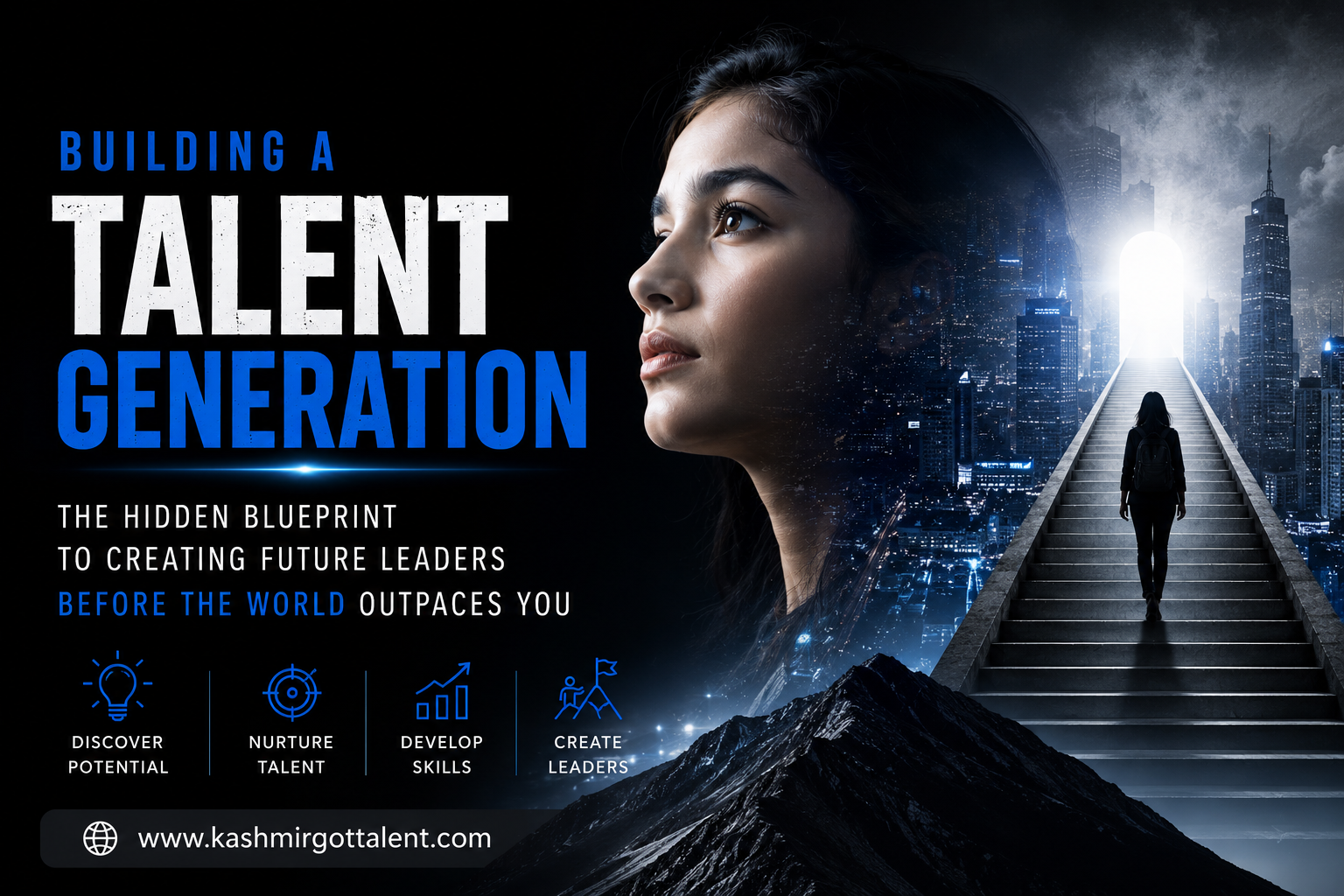
In a world where industries evolve faster than education systems, the real advantage is no longer technology alone, but the ability to build a generation of talent that can adapt, lead, and innovate before disruption becomes the new normal. Organizations, communities, and even nations are no longer competing on resources; they are competing on how effectively they can identify, nurture, and scale human potential.
This is not just a strategy. It is a survival framework for the future.
A talent generation is not created by chance. It is built through intentional systems that combine education, exposure, mentorship, emotional intelligence, and real-world problem solving. Those who understand this early will shape the next decade. Those who ignore it will struggle to stay relevant.
The urgency is real. We are entering a time where skills expire faster than they are learned. Degrees alone no longer guarantee opportunity. Certifications alone no longer guarantee success. The world now rewards adaptability, creativity, and execution under uncertainty.
The question is no longer “What do you know?”
It is “How fast can you learn, unlearn, and rebuild yourself?”
The foundation of a talent generation begins with mindset transformation
Before skills are taught, mindset must be reshaped. A true talent ecosystem begins by replacing fear-based learning with curiosity-driven growth. When individuals are trained to see challenges as opportunities rather than barriers, they naturally evolve into problem solvers instead of passive learners.
A talent generation thrives in environments where failure is not punished but analyzed. Where experimentation is encouraged. Where young minds are exposed to real-world complexity instead of artificial simplicity.
Without this foundation, even the best training systems collapse under pressure.
Education must evolve from information delivery to capability building
Traditional education systems were designed for stability, not disruption. But the modern world demands the opposite. Building a talent generation requires shifting from memorization to application.
Learners must be placed in environments where they are forced to think critically, collaborate across disciplines, and build solutions that have real consequences. This includes entrepreneurship exposure, digital literacy, communication mastery, and emotional intelligence development.
The future belongs to those who can connect knowledge with action faster than others.
Exposure is the multiplier of hidden potential
Talent is not only developed in classrooms. It is revealed through exposure.
When individuals are exposed to global ideas, diverse cultures, industry leaders, and real challenges, their perspective expands. This expansion is what transforms average ability into extraordinary capability.
A strong talent ecosystem ensures that exposure is not a privilege but a structured part of growth. Internships, mentorship programs, live projects, competitions, and cross-border collaborations become essential tools for unlocking potential.
Without exposure, talent remains trapped. With exposure, it accelerates exponentially.
Mentorship is the bridge between potential and performance
No talent generation can be built without guidance. Mentorship is what turns raw ability into refined skill.
A mentor does not just teach. A mentor accelerates learning by compressing years of experience into actionable insight. In a fast-changing world, this compression is invaluable.
Organizations and communities that prioritize mentorship create individuals who make fewer mistakes, take smarter risks, and develop confidence earlier in their journey.
Emotional intelligence defines long-term success
Technical skills may open doors, but emotional intelligence determines how far someone goes.
The ability to communicate clearly, handle pressure, resolve conflict, and work in teams is becoming more valuable than ever. In fact, many high-performing systems fail not because of lack of intelligence, but because of lack of emotional alignment.
A talent generation must therefore train individuals to understand themselves first before trying to master the external world.
Real-world integration is the ultimate test
A system that produces talent without real-world application is incomplete.
The strongest talent ecosystems continuously integrate learners into real environments where they must perform under pressure. Whether it is startups, research labs, community initiatives, or digital platforms, real execution is what separates theory from mastery.
This is where talent becomes transformation.
The urgency we cannot ignore
We are entering an era where artificial intelligence, automation, and global competition are redefining every industry. The speed of change is no longer gradual. It is exponential.
This means one thing clearly: talent development can no longer be delayed, simplified, or generalized.
Those who invest in building talent today will control innovation tomorrow. Those who wait will inherit disruption without preparation.
Final thought
Building a talent generation is not a project. It is a long-term commitment to shaping human capability at scale. It requires vision, discipline, and the willingness to think beyond short-term outcomes.
The future will not be defined by the strongest systems, but by the most adaptable minds.
And adaptability begins with how we build people today.