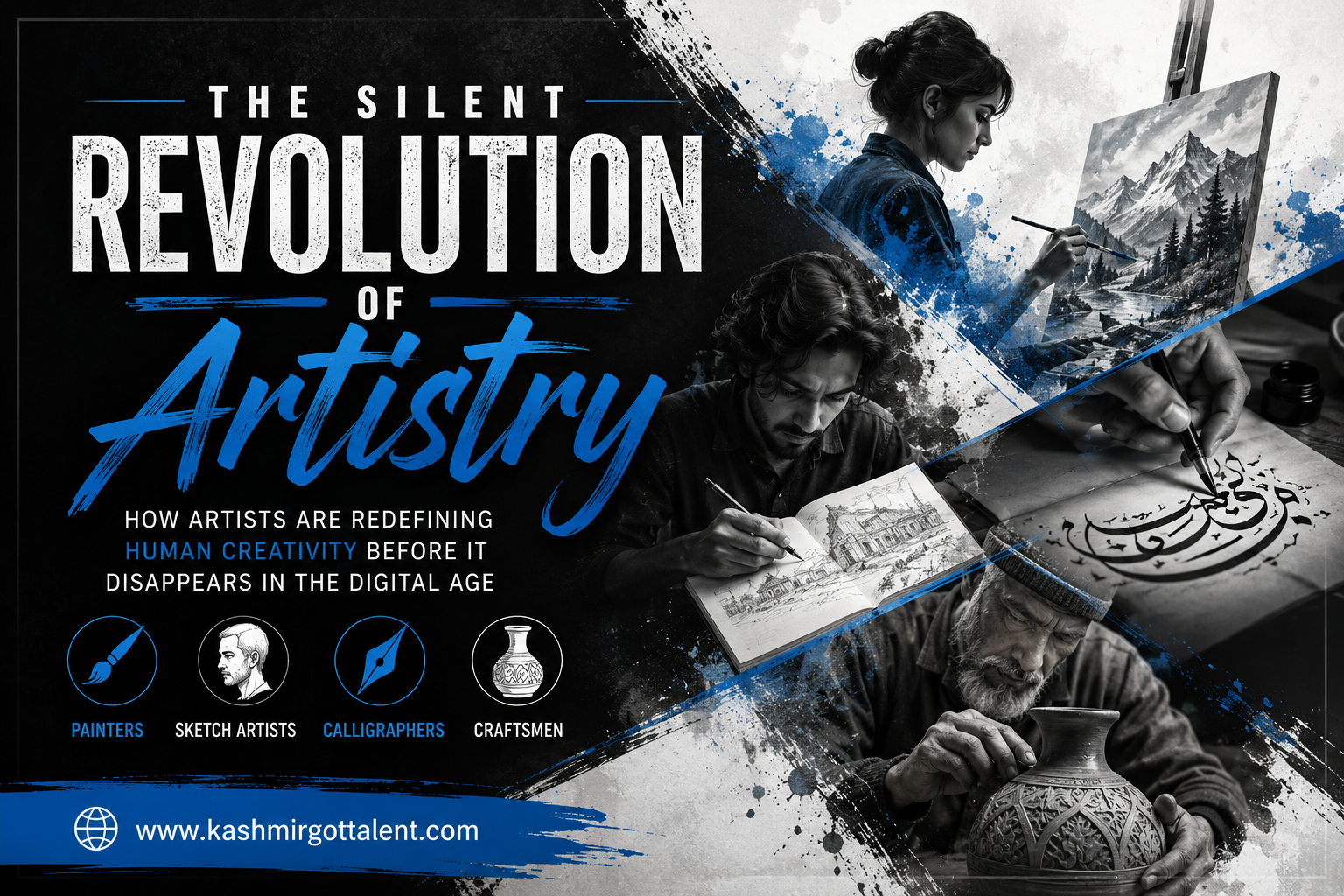
The Forgotten Power of Human Hands: Why Artistry Is No Longer Optional in a Machine-Driven World
We are living in a time where speed is valued more than soul, and automation is replacing intention. Yet in the middle of this transformation, a quiet revolution is happening—led by painters, sketch artists, calligraphers, and craftsmen who are preserving something machines can never replicate: human expression through touch, patience, and imperfection.
This is not just art. This is survival of identity.
Every brushstroke, every carved detail, every inked curve carries something deeper than aesthetics—it carries memory, culture, emotion, and discipline. And in a world overflowing with digital content, these handmade expressions are becoming rare, powerful, and urgently valuable.
Why Artistry Matters More Now Than Ever Before
Artistry is no longer confined to galleries or exhibitions. It is becoming a global language of emotional intelligence.
Painters are not just creating visuals—they are translating emotion into color. Sketch artists are documenting reality in its rawest form, untouched by filters or algorithms. Calligraphers are preserving the sacred discipline of language as visual rhythm. Craftsmen are rebuilding the meaning of durability in a disposable world.
The urgency is real: when everything becomes automated, authenticity becomes luxury.
And that luxury is disappearing faster than we realize.
Painters: Interpreting Emotion Through Color Before Words Fail
Painting is not decoration. It is interpretation.
A painter sees what most people feel but cannot express. Each stroke becomes a decision, each shade becomes a psychological imprint. In modern society, where attention spans are shrinking, painting forces the viewer to slow down and feel again.
This is why original paintings are gaining global demand—not because they are beautiful, but because they are emotionally irreplaceable.
Sketch Artists: The Truth-Tellers of Visual Reality
Sketching is the most honest form of visual storytelling. There is no distraction of color, no digital enhancement, no artificial correction.
Only truth.
Sketch artists capture life in motion—faces, architecture, emotions, and moments that exist for only seconds. In a world where images are heavily edited, sketches bring back trust in what is seen.
Their work is not just art. It is documentation of reality before it changes or disappears.
Calligraphy: The Discipline of Beauty in Every Stroke
Calligraphy is where language becomes art and discipline becomes elegance.
Every stroke in calligraphy demands control, patience, and repetition. Unlike typing, where words are instant, calligraphy requires intention. It slows down thought, forcing the mind to align with the hand.
This is why calligraphy is experiencing a global revival. It represents resistance against speed culture. It is mindfulness made visible.
In an age of digital fonts, handwritten beauty has become a form of luxury communication.
Craftsmen: The Builders of Meaningful Objects in a Disposable Era
Craftsmanship is not just skill—it is responsibility.
Craftsmen create objects designed to last, not to be replaced. Whether it is woodwork, metalwork, pottery, or fabric art, craftsmanship connects humanity back to material reality.
Every crafted object carries time inside it. Time spent shaping, refining, correcting, and perfecting.
In contrast to mass production, craftsmanship reminds us that value increases with effort, not speed.
This is why handcrafted goods are becoming global symbols of authenticity and status.
The Urgent Truth: Why Artistry Must Be Preserved Now
We are approaching a critical turning point where creative identity risks being replaced by automated production systems. While technology enhances efficiency, it cannot replicate emotional depth, cultural nuance, or human imperfection.
If artistry disappears, we lose more than skills—we lose perspective.
This is not a nostalgic concern. It is a cultural emergency.
Supporting painters, sketch artists, calligraphers, and craftsmen is no longer optional appreciation. It is active preservation of human intelligence.
How to Take Action and Support Artistry Today
Preserving artistry is not passive. It requires conscious decisions:
Choose handmade over mass-produced when possible
Support independent artists and local craftsmen
Invest in original artworks instead of replicas
Encourage children and students to practice drawing and writing by hand
Value time spent creating, not just consuming
Every small decision contributes to keeping human creativity alive.
Final Thought: The Future Will Be Defined by What We Refuse to Forget
Technology will continue to evolve. Automation will continue to expand. But the human need for expression will never disappear.
Painters, sketch artists, calligraphers, and craftsmen are not just creators of beauty—they are guardians of identity in a rapidly digitizing world.
The question is no longer whether artistry matters.
The question is whether we will still have it tomorrow.